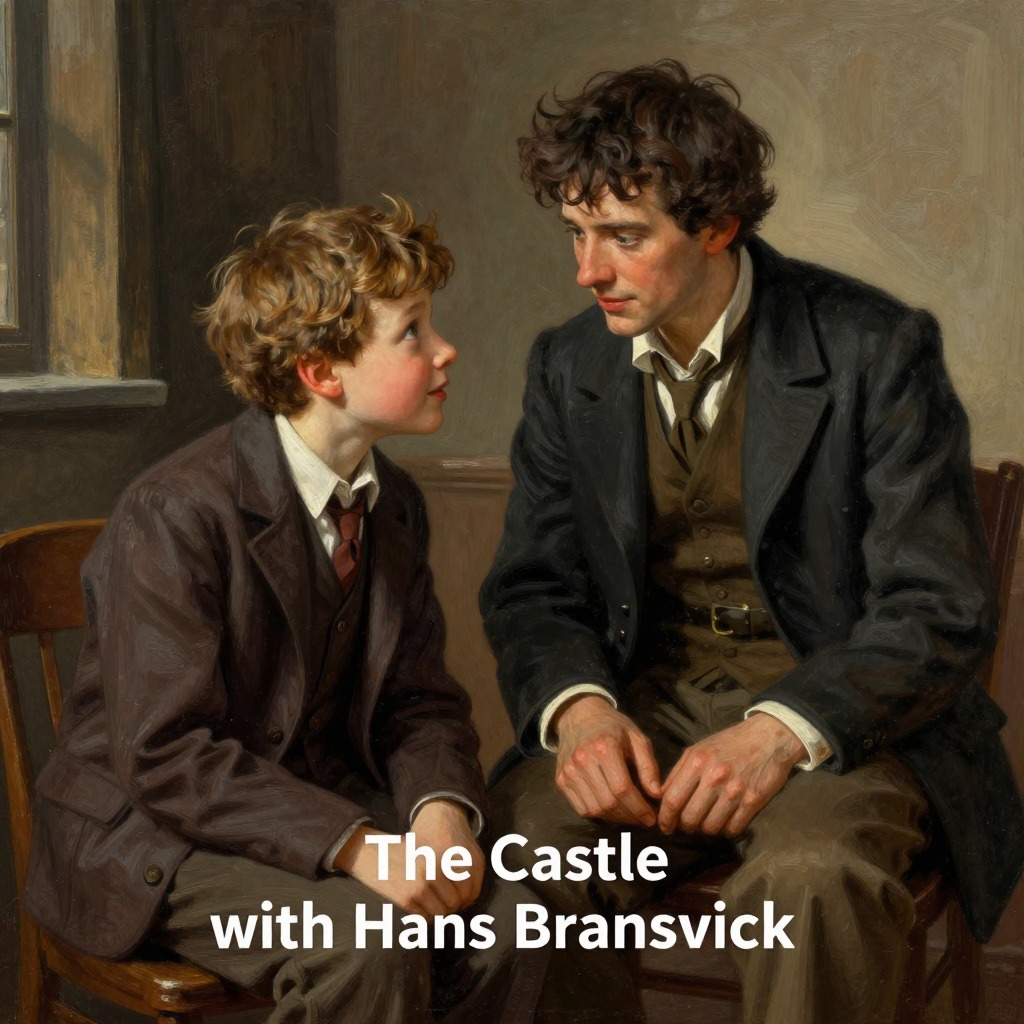
Hans Brunswick
Hans Brunswick is a twelve-year-old schoolboy in the village who, moved by compassion for K.'s bleeding hand, deserts his classroom to offer help, becoming a brief but significant ally. His conversations with K. reveal the deep entanglement of family loyalty, the village's social hierarchies, and the desperate hopes placed on the land surveyor as a potential savior.
Identity and Introduction
Hans Brunswick is a twelve-year-old boy in Class Four, the son of Otto Brunswick, the master shoemaker who lives in Madeleine Alley. He first appears in the narrative when he approaches K. during a chaotic morning at the school, where K. has just been scratched by Miss Gisa's cat. Hans is deeply upset by the sight of K.'s bleeding hand and makes up his mind to go over to K.'s side, risking severe punishment by deserting his classroom. He is described as a boy with big brown eyes, standing very upright with his arms at his sides, speaking softly. His manner is a curious blend of childish innocence and a gravity that seems beyond his years, often speaking like a clever, energetic, and farsighted man, only to suddenly revert to being a schoolboy who misunderstands questions and speaks too quietly.
The Conversation with K.
Hans's conversation with K. and Frieda in the schoolhouse is a long and revealing exchange. He asks eager, pointed questions, as if wanting to learn the most important facts quickly so he can decide what is best for K. and Frieda. He tells them about his mother, who is poorly, and his sister, also named Frieda, whom he dislikes having the same name as the woman questioning him. He speaks of his father with respect or even fear, but only when they are not also talking about his mother. Hans reveals that his father is the leading shoemaker in the village, giving work to other shoemakers such as Barnabas's father, and that his mother has already asked after K. once. He offers to help K. with his work, and if he cannot do it himself, he will ask his mother to help, for when his father is in difficulty he always asks his mother for help.
The Plan to See Hans's Mother
K. becomes interested in Hans's mother, suspecting she may have connections to the castle, and offers to visit her, claiming some medical knowledge and experience. Hans is initially eager but then becomes protective, explaining that no strangers can visit his mother, as she must be spared any strain. He reveals that his father was angry with K. and wanted to punish him, but his mother restrained him. The two eventually come to an understanding, planning for Hans to tell his mother the truth and for K. to visit her secretly while his father is away at the Castle Inn. Hans agrees to K.'s suggestion of saying he wants to speak to Brunswick about the post of land surveyor, though he is gloomy about it. The plan is fraught with difficulties, and Hans is deeply concerned about his mother's sensitivity and his father's potential reaction.
Hans's View of K.
When Frieda asks Hans what he wants to be when he grows up, he says he wants to be a man like K. When pressed for reasons, he cannot give any, but further questions reveal his thinking. Hans sees that K.'s present situation is dismal and humiliating, and he would like to keep his mother away from the sight of K. Yet he has come to K. for help, and his mother herself has mentioned K. These opposing ideas lead him to believe that K. might be in a low position now but will triumph over everyone in an almost unimaginably distant future. This future, foolish as it may seem, looks alluring to Hans, and at that price he is ready to accept K. as he is. The particularly childish and precocious nature of his wish lies in the fact that Hans looks down on K. as if he were a younger boy with a longer future ahead of him. K. cheers him up by promising to make him a walking-stick even better than his own gnarled one, and Hans leaves cheerfully, pressing K.'s hand firmly and saying, "So, I'll see you the day after tomorrow."
Significance
Hans Brunswick serves as a mirror to K.'s own situation, reflecting the village's complex social dynamics and the desperate hopes placed on the land surveyor. His innocent yet precocious nature highlights the themes of family loyalty, the search for help, and the ambiguous position of K. in the village. Hans's belief in K.'s future triumph, despite his current humiliation, underscores the novel's exploration of hope and despair in the face of an incomprehensible authority. His character also reveals the deep entanglement of the Brunswick family with the village's power structures, as his father is a leader of those who wanted a land surveyor appointed, and his mother is a mysterious figure possibly connected to the castle.